There is no shortage of bar lists. What almost nobody explains is how it is done: when you go out, what you order, where you pay, why nobody sits down and why people leave when the pintxo was excellent. Going out for pintxos is not having dinner. It is something else, with its own rules, and learning them changes the evening.
Gros is a good place to learn them: a residential neighbourhood with long-established counters, so what you see around you is what people really do, not what is done for visitors. From the apartment you step out of the door and you are in it.
What a pintxo is
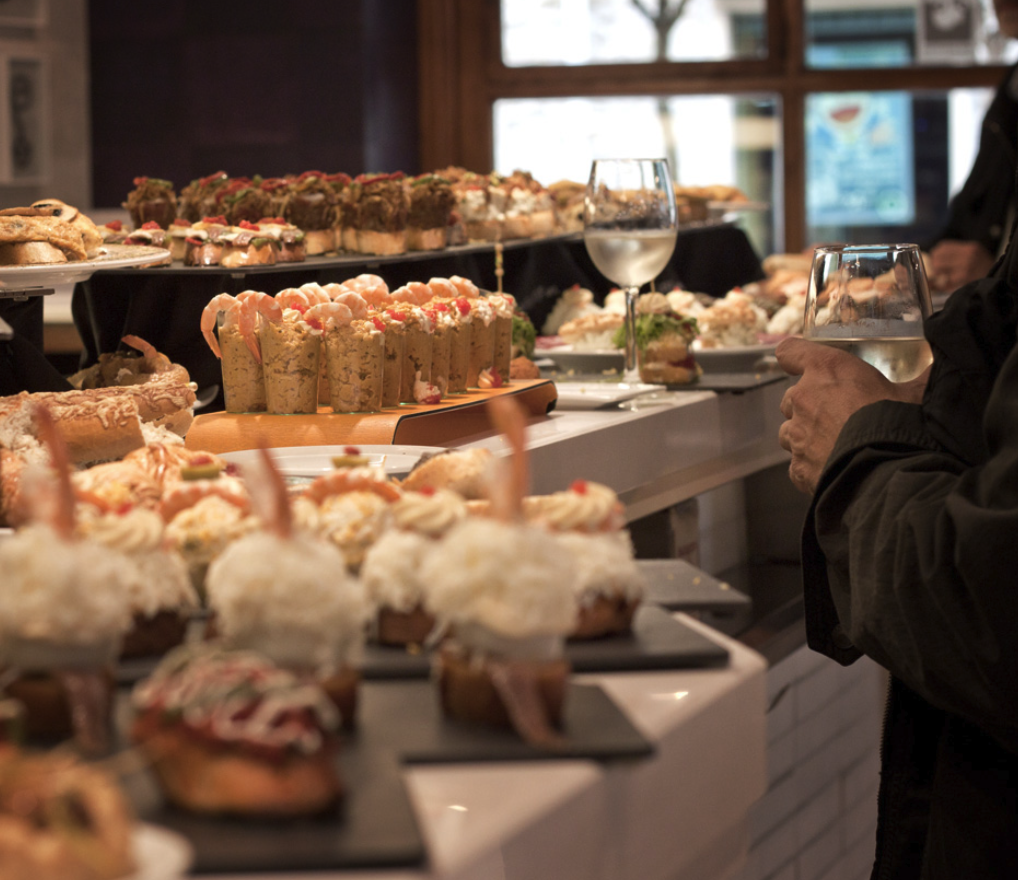
A pintxo is a small portion eaten standing up, at the counter, alongside a drink. That's all. It is not a tapa — nothing comes free with the drink: you order it and pay for it — and it is not a half portion.
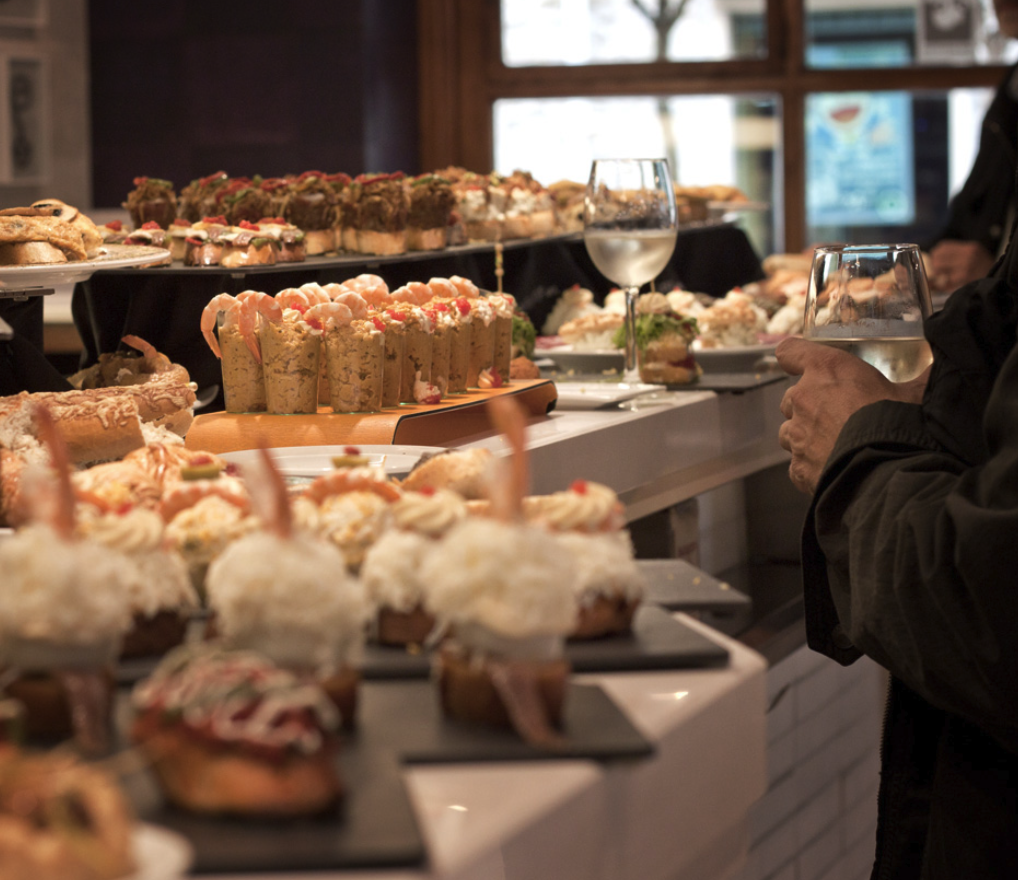
There are two families. The cold ones sit on the counter in plain sight, on bread or in a small dish: you take them yourself or point and they are served. The hot ones are ordered from the kitchen and come out made to order; they tend to be the best and they are almost never on display. If you see a blackboard hanging up, that is where they are.
How the counter works
The sequence is always the same, and fast:
- You go in and head for the counter. Don't wait to be seated: nobody will.
- You order the drink first. That is the signal you have been served.
- You choose the pintxo: point at the cold ones on the counter, or order a hot one off the blackboard.
- You eat standing, at the counter or leaning on a high table.
- You pay when you leave, all together. You say what you have had and they charge you on trust; in Gros almost everywhere takes cards.
- You leave and carry on.
Two things throw people at first. One: in some old-school bars the used napkin goes on the floor, and it is not filth, it is custom; if you see paper under the counter, you are not in the wrong place. Two: if the bar is full, people push through to the counter and order out loud. It is not rudeness, it is the system. Speak up without embarrassment.
The rhythm: one or two things, then move on
This is the hardest part to accept. In each bar you have one drink and one or two pintxos, and you change places. Even if it was good. Even if there is room. The point of the poteo — the round — is the sum of the counters, not the long stop.
You make between four and six stops in an evening. Each one lasts fifteen or twenty minutes. Between bars there are two or three minutes on foot, and that walk is part of the plan.
Choose a different pintxo at each place. Almost every bar has two or three things it does better than anyone and the rest is filler: if you repeat a category, you miss the best thing at the next one.
When people actually go out
Local timings are not the guidebook timings. The midday round runs from 13:00 to 14:30, before lunch, and it is the calmest. The evening one starts around 19:30 or 20:00 and stretches to 22:30.
At 18:00 the counters are empty or half-stocked, and many kitchens have not brought out the hot pintxos yet. If you arrive then, you see far less than there is. On Sunday afternoons the neighbourhood eases off considerably and several places close.
Thursday pintxopote
On Thursday evenings many bars in Gros offer a pintxo plus a drink at a fixed, closed price. That is the pintxopote, a neighbourhood custom rather than a tourist draw: locals go out, it starts around 19:30 and the streets fill up.
If your trip takes in a Thursday, go out at that hour. It is the liveliest night of the week and the cheapest. Also the loudest: if you want a quiet conversation, pick any other day.
What people drink
What you order is a zurito: a small glass of beer, around 100 ml. It is small on purpose: you are going to have five. Ordering a pint at every stop is the fastest way to ruin the evening.
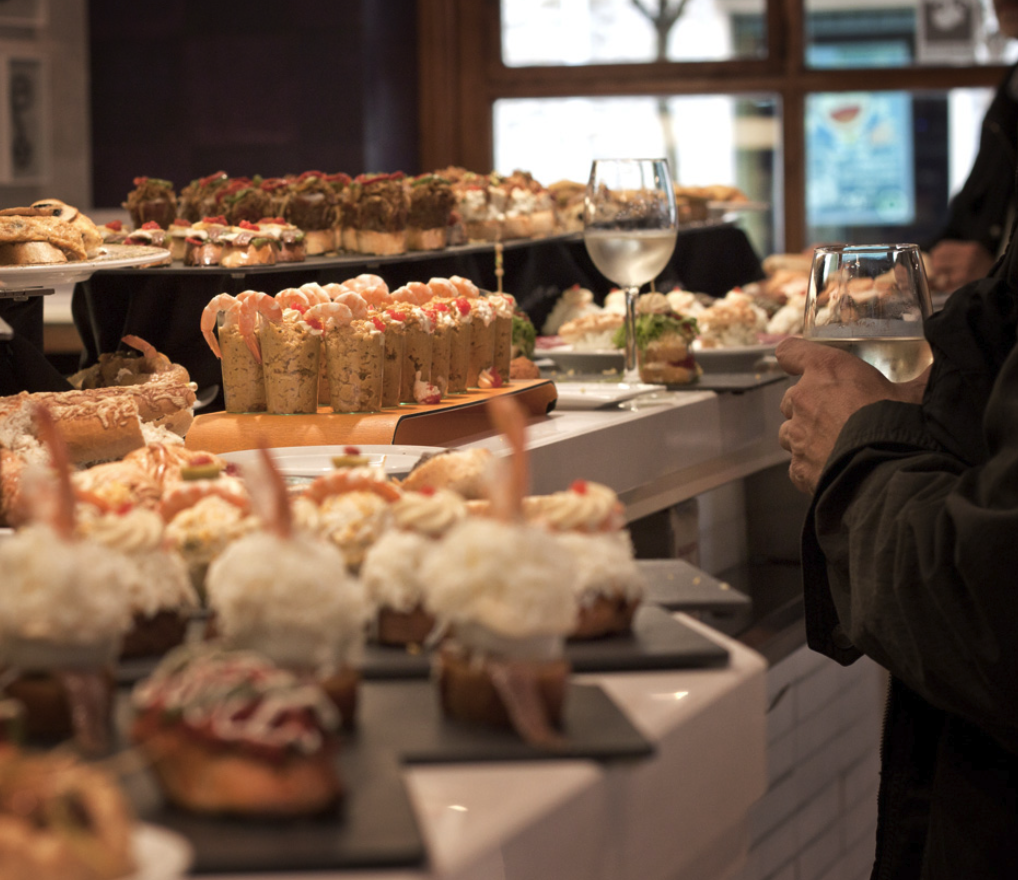
Txakoli is the local white wine: sharp, low in alcohol, slightly sparkling, poured from a height so it aerates. It goes with almost everything. Natural cider is served at many counters outside the cider house season, poured in small measures. For red wine, you ask for a corto, half a glass.
Without alcohol it works just as well: grape juice, alcohol-free beer, or sparkling water. Nobody will look at you strangely.
What to budget
Prices change from bar to bar, so we are not giving you figures that go stale. The useful rule is a different one: work it out per stop, not per bar. A short drink plus a pintxo is the unit of spending; multiply by the number of stops.
Hot pintxos cost more than cold ones off the counter, and seasonal ones — wild mushrooms, hake cheeks, elvers — considerably more. If something has no price on show, ask before ordering: it is normal and nobody takes offence.
Why Gros is a better base than the Old Town
The Old Town has magnificent counters and you should go. But as a base for sleeping and going out daily it has three drawbacks: it gets very full, it is more expensive and the night noise reaches the beds.
Gros offers the same thing on a smaller scale. The bars are spread along wide, flat streets rather than alleys, so the walking is better and getting in is easier. The crowd is mostly local. And when you want the Old Town, it is ten minutes on foot across the bridge. The neighbourhood is worth far more than its counters, and we cover it in the guide to Gros.
Pintxos with children or in a wheelchair
With children, go at midday. Between 13:00 and 14:30 the bars are clear, there is room at the high tables and nobody is in a hurry. In the evening, from 21:00, it fills up and is not a comfortable plan. Omelette, croquettes and ham always work.
In a wheelchair, Gros is on your side: it is flat, the pavements are wide and the crossings have dropped kerbs. Even so, many counters are old and narrow, some have a step at the door and hardly any have an adapted toilet. Two things that work: go out at midday, when there is real room to manoeuvre, and choose bars with a terrace, where you order and eat without depending on a gap at the counter. From our apartment, which has barrier-free access and a lift, the first counters are a few minutes away on flat pavement.
Frequently asked questions
Do you pay at each bar or at the end of the night?
At each bar, as you leave that bar. You say what you have had and they charge you; you can almost always pay by card.
Can you make a whole dinner out of pintxos?
Yes, and a lot of people do. Four or five stops with one pintxo at each is more than enough.
Do you leave a tip?
Not expected here. At most, you leave the small change.
What is the worst day for pintxos in Gros?
Sunday afternoon and Monday. Several bars close and the counters are much less stocked.